
Review By: Jim West
Directed by: Rian Johnson
Written by: Rian Johnson
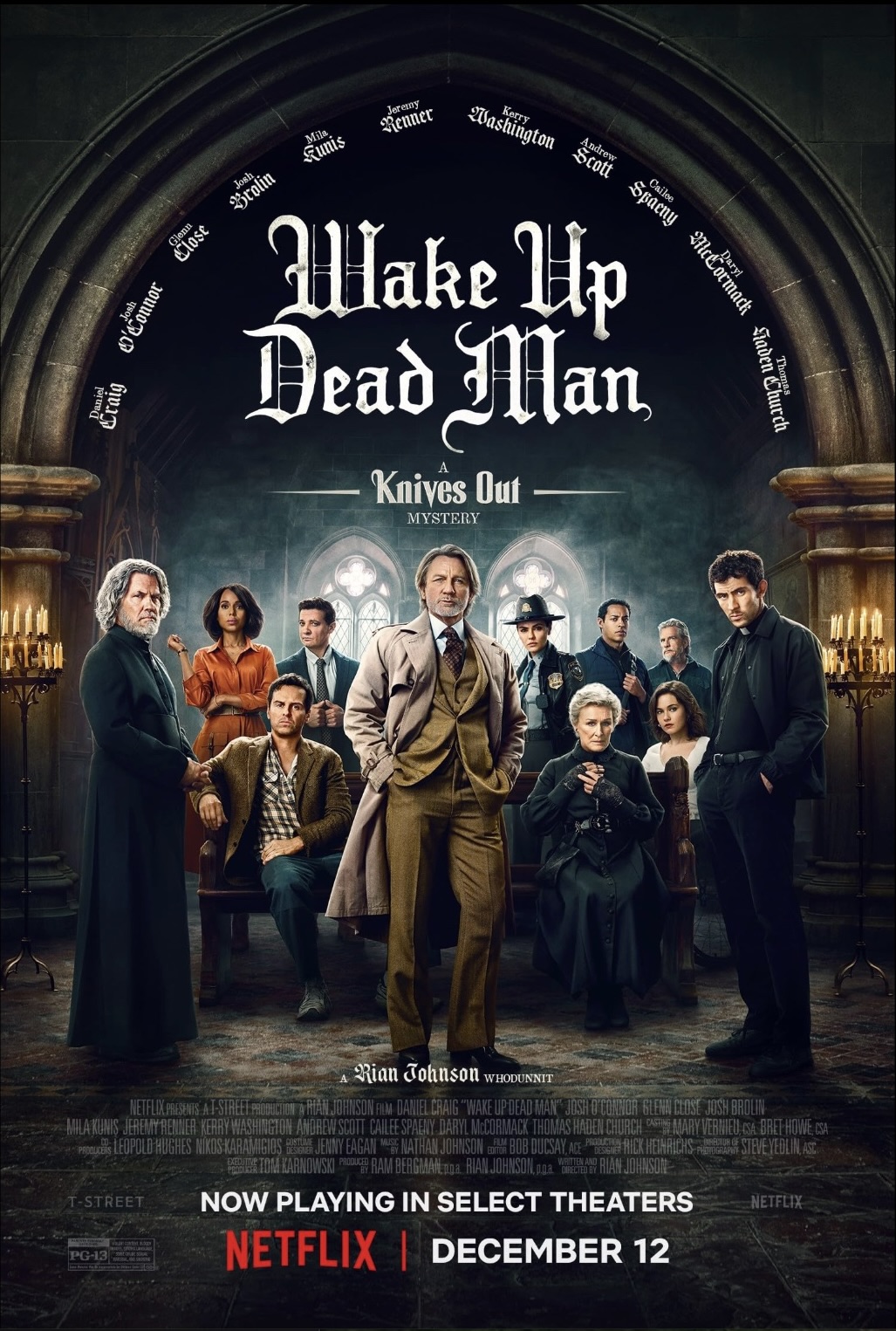
Written and directed by Rian Johnson, Wake Up Dead Man: A Knives Out Mystery continues his carefully constructed Knives Out series—an anthology that uses the whodunit format not just to entertain, but to dissect human behavior under pressure. Each entry stands alone while pushing the genre’s thematic boundaries, and this may be the most morally complex chapter yet. Instead of creating just an escalating spectacle, Johnson doubles down on flawed people, difficult choices, and the uncomfortable space where belief and self-interest collide. This review will be a rare Writing Movie ‘RIGHT’.
Here come the spoilers…
The mystery centers on the murder of Monsignor Jefferson Wicks during a Good Friday service, staged as an impossible locked-room crime inside a rural church. What initially appears to be a singular act of violence slowly unravels into a web of previously unseen complexity driven by secrets, greed, and moral compromise. The plot reveals layered manipulation involving tranquilizers, misdirection, and multiple accomplices, all tied to a hidden diamond and the fear of exposure. Crucially, every character’s involvement is rooted in personal conflict—faith tested by greed, loyalty strained by fear, and silence enforced through blackmail. The crime isn’t the work of one mastermind, but the result of intersecting moral failures.
The ending reinforces that complexity rather than simplifying it. The truth emerges not through a single theatrical reveal but through the collapse of lies that can no longer coexist. The conspiracy implodes under the weight of guilt and consequence, leading to both legal justice and moral reckoning. The diamond is hidden away, temptation rejected rather than rewarded, and leadership passes to someone shaped by repentance rather than ambition. It’s an ending that favors meaning over shock—faith restored not because it is pure, but because it has been tested and survived.
From there, the film’s greatest strength becomes clear: its commitment to character over cleverness. This isn’t a puzzle box built solely on mechanics; it’s a moral labyrinth where faith, loyalty, guilt, and blackmail constantly collide. Every suspect isn’t just hiding a secret—they’re carrying a belief system, and the tension comes from watching those beliefs fracture under pressure.
The film treats faith not as window dressing, but as an active force in the narrative. Faith here isn’t certainty or righteousness; it’s flawed, compromised, and often weaponized. Characters invoke faith to justify loyalty, loyalty to excuse corruption, and corruption to rationalize betrayal. That triangle—faith versus loyalty versus blackmail—is not just thematic, it’s structural, shaping every major turn in the story.
The characters are allowed to be genuinely imperfect. No one is purely innocent, and no one is cartoonishly villainous. Even the most morally compromised figures are given understandable—if not forgivable—reasons for their actions. The film trusts the audience to sit with discomfort rather than rushing toward clean answers. Benoit Blanc feels perfectly calibrated for this story. Instead of dominating the film with theatrics, he functions as a quiet observer, allowing contradictions to surface naturally. His role reinforces one of the film’s most innovative ideas: truth doesn’t emerge because someone is cleverer than everyone else, but because lies built on conflicting values inevitably collapse.
The plot mechanics are intricate without being showy. Each twist is motivated by character, not convenience. Blackmail works because someone cares too much. Betrayal happens because loyalty is misplaced. Violence erupts because faith is twisted into justification. Nothing feels arbitrary, and that cohesion is rare in modern mystery writing.
Most importantly, Wake Up Dead Man understands that resolution doesn’t require moral purity. The ending offers consequence, reckoning, and reflection rather than a triumphant cleansing of wrongdoing. It respects the complexity of what came before instead of opting to simplify it for comfort.
In a genre increasingly obsessed with subversion for shock value alone, Wake Up Dead Man: A Knives Out Mystery succeeds by doing something far harder: earning its turns through character, theme, and intention.
Thanks for reading Writing Movie “RIGHT.”