
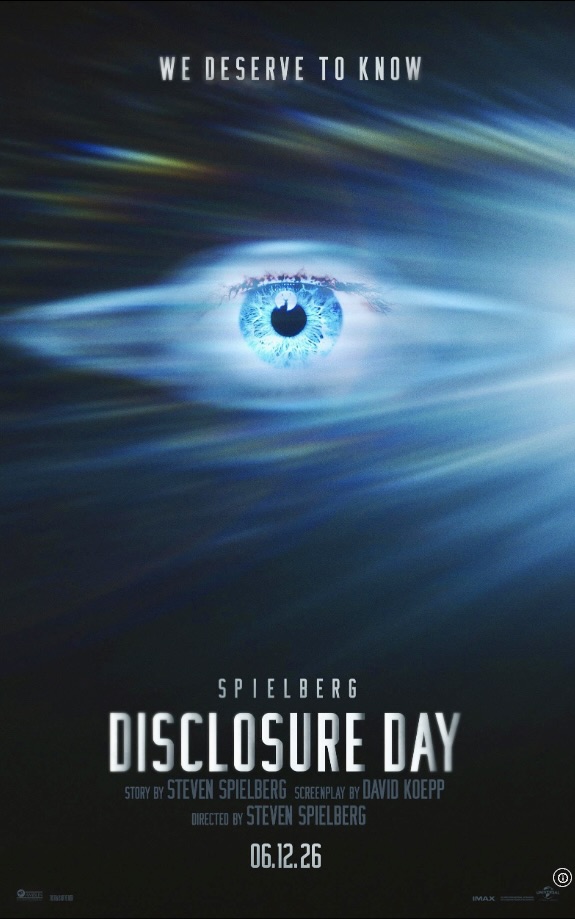
Directed by: Steven Spielberg
Written by: Steven Spielberg and David Koepp
Steven Spielberg returning to alien disclosure should have been one of the most exciting science fiction
events in years. Few directors understand wonder, fear, mystery, and humanity’s reaction to the
impossible better than Spielberg. Disclosure Day has a fantastic setup with Wardex hiding alien
technology, whistleblowers trying to reveal the truth, and the world standing on the edge of the greatest
revelation in human history. The premise is strong, the visuals are strong, and there are moments where
the movie feels like it is reaching for something classic. Unfortunately, the writing does not always
support the size of the story being told. For a film about alien technology and global secrecy, too much
of the plot feels underdeveloped, too many motives feel thin, and Wardex is never as terrifying as it
should be.
Here come the spoilers…
My biggest issue with Disclosure Day is Wardex. This organization should be one of the most
frightening entities ever put into a Spielberg film. Wardex has supposedly spent decades studying alien
technology, hiding world-changing secrets, and operating beyond normal accountability. Yet when
Daniel and Margaret go on the run, Wardex often behaves like a generic private security team with black
SUVs, guards, radios, and poor pursuit skills. If Wardex has access to technology beyond human
understanding, then their methods should feel beyond human understanding. Instead, they are described as advanced but written as conventional.
This is where the movie misses one of its biggest opportunities. Wardex should have used alien-derived
tools that made escape feel nearly impossible. Imagine heartbeat tracking, biological signature detection, perception distortion, holographic misdirection, or a discombobulator-style weapon that could scramble balance, memory, hearing, or vision without firing a shot. Every room should have felt compromised, every stranger should have felt suspicious, and every escape should have felt like a miracle. Instead, Daniel and Margaret too often get away because Wardex suddenly becomes less capable than the premise requires. As the only known company to possess alien technology and supposedly to have reverse-engineered it, Wardex should not simply chase people; it should make them question reality itself.
The alien technology is the second major wrong. Mystery is fine, and Spielberg has always understood
that the unknown can be more powerful than explanation. But mystery still needs rules. In Disclosure
Day, the alien device seems to do whatever the scene needs it to do: manipulate people, connect with
Margaret, create projections, alter perception, and possibly control bodies. The problem is that the film
never clearly establishes what it can do, what it cannot do, who can use it, and why it responds to certain people. Without clearer rules, the technology feels less like an awe-inspiring discovery and more like a
screenwriting convenience.
A few simple boundaries would have made the device far more powerful and believable.
Daniel also needed a stronger personal motive. Wanting the truth revealed is a good start, but for a
character who risks his life to expose the greatest secret in human history, the audience needs more.
Why Daniel? Why now? What did Wardex do that pushed him past the point of no return? The film
would have been stronger if Daniel had discovered that Wardex was not merely hiding alien life, but
actively using alien technology against civilians, journalists, religious leaders, or political figures. That
would have turned his whistleblower arc from a general moral stance into a deeply personal mission. It
would also have made Wardex feel more dangerous and morally corrupt.
Margaret is another area where the film gives us importance without enough explanation. She is clearly
central to the alien mystery, but the movie does not fully explain why. Was she chosen, changed,
exposed, connected, or awakened? Is she a translator, a witness, a key, or something more? A stronger
version of the story would have tied Margaret’s connection directly to the theme of disclosure. Maybe
Wardex failed because it treated the alien technology as a weapon, while Margaret succeeds because she approaches the alien presence with empathy, trust, or openness. That would have felt far more
emotionally satisfying and much more Spielbergian.
Jane’s faith conflict could have been one of the richest parts of the movie, but it is treated too simply.
The film seems to suggest that alien life would automatically threaten belief in God, when for many
people it might expand their understanding of creation. Jane should not have been written merely as
someone afraid of disclosure. She should have been Daniel’s true moral counterweight. Daniel believes
truth must be revealed no matter the cost, while Jane could have argued that truth without preparation
can destroy people. That is a far more interesting conflict than fear versus revelation. The better question
is not whether aliens destroy faith, but whether humanity is mature enough to receive the truth without
turning it into chaos.
The final wrong is the ending, but it may also be the best doorway forward. A movie called Disclosure
Day cannot build everything toward disclosure and then barely explore what disclosure actually does to
the world. The reveal should not feel like the finish line; it should feel like the beginning of the most
interesting part of the story.
The best way forward with the world Spielberg has introduced may actually be a television series that
answers many of the questions the film raises. The series could pick up with the government dismissing
the disclosure event as fake news, AI deepfakes, and mass manipulation, leaving half the world
convinced and the other half skeptical. It could follow an activated person as they try to understand the
aliens’ motives, knowledge, and purpose, while also following the Wardex agent assigned to find and
capture them, giving us both sides of the secrecy argument. That would allow the story to explore
believers, nonbelievers, helpers, informants, fear, faith, government denial, and the dangerous gray area
between truth and control. Disclosure Day has wonder, ambition, and a great premise, but it needed
another writing pass; make Wardex terrifying, give the alien technology rules, deepen the motives, and
then let a series show us what happens when disclosure truly changes the world.
Thanks for reading Writing Movie “WRONGS.”