
Review By: Jim West
Directed by: Christopher Nolan
Written by: Christopher Nolan
Christopher Nolan has built one of the strongest and most consistent filmographies of any modern director. Oppenheimer, Inception, Interstellar, The Dark Knight, and Memento are not simply great movies; they possess that rare rewatchable quality created through exceptional cinematography, layered storytelling, and details that reveal more with each viewing. Homer’s The Odyssey is perhaps not the easiest literary work to bring to life, but Nolan pulls out every filmmaking trick he has learned throughout his career to place its enormous journey on the screen. He uses practical effects, real locations, massive sets, IMAX photography, and an extraordinary cast to create something that feels genuinely epic. There is very little here that I would attempt to correct, which is why this review will be a rare Writing Movie “RIGHT.”
Here come the spoilers…
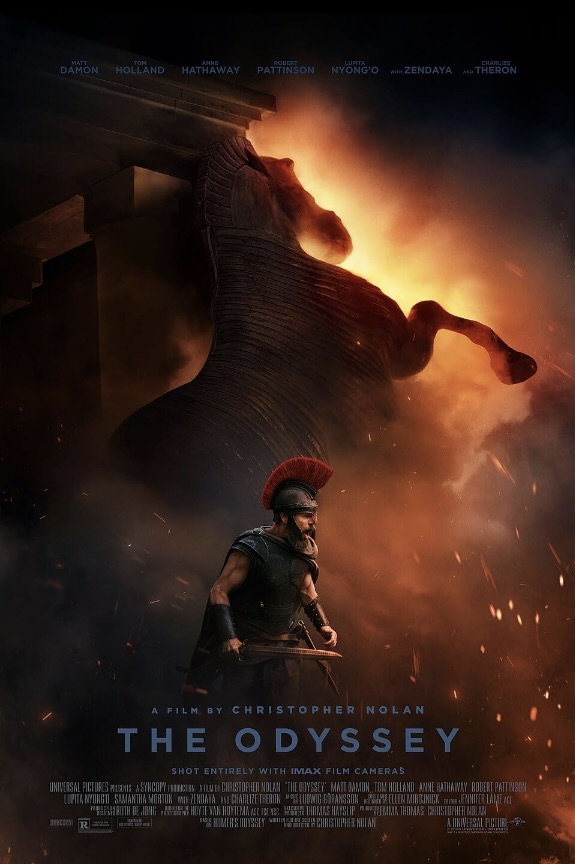
The story begins near the end of the Trojan War, where Odysseus has already spent years separated from his home, his wife Penelope, and his son Telemachus. Before the army departs, the men of Ithaca are selected to fight through a lottery. Antinous is chosen, but because of his wealth and cowardice, he convinces the young Sinon to take his place with the promise that Sinon’s family will be financially rewarded. Odysseus allows the substitution, unknowingly making a decision that will haunt him for years to come. After Troy finally falls through Odysseus’ wooden horse strategy, his exhausted army begins what should be a journey home. Instead, pride, violence, temptation, monsters, angry gods, and the consequences of war turn that journey into another ten years of suffering.
The film moves through the legendary beats of Odysseus’ voyage with remarkable confidence. The fall of Troy, the Cyclops, Circe, Calypso, the Sirens, the loss of his ships and men, and the deterioration of hope all contribute to Odysseus becoming a man crushed beneath the weight of every decision he has made. My one issue with the film involves Sinon. We see him as a young man taking Antinous’ place, and we later see the guilt his death creates within Odysseus, but we never experience the years between those moments. A brief montage showing Sinon fighting beside Odysseus throughout the nine or ten years of war would have added tremendous emotional weight. Show Sinon beginning as a frightened boy, slowly becoming a capable soldier, sharing meals with Odysseus, surviving battles beside him, and perhaps viewing him as a mentor or father figure. Then, when Sinon is manipulated, sacrificed, and ultimately dies, Odysseus’ grief becomes nearly unbearable because we would have watched their relationship grow. It is a small missing piece, but one that could have made the film’s strongest source of guilt even more powerful.
Beyond that minor character issue, Nolan executes the story with astonishing skill. Odysseus’ journey is not presented merely as a series of encounters with famous monsters. Each trial strips away another part of the warrior who left Ithaca. The victories never come without loss, and the creatures are not simply obstacles; they become reflections of pride, hunger, fear, temptation, and the destructive impulses carried home from war. Meanwhile, Penelope’s resistance against the suitors and Telemachus’ struggle to become a man give the story an emotional destination beyond survival. The phenomenal cast treats the material with the necessary seriousness, with Matt Damon carrying the physical exhaustion, intelligence, guilt, and broken humanity of Odysseus. Anne Hathaway gives Penelope strength without removing her pain, Tom Holland captures Telemachus’ uncertainty and determination, and Robert Pattinson makes Antinous a repulsive embodiment of privilege, cowardice, and entitlement. Even within a production of this scale, the performances never disappear beneath the spectacle.
From a technical perspective, The Odyssey is almost impossible not to admire. Knowing that Nolan and cinematographer Hoyte van Hoytema filmed this enormous production using heavy IMAX film cameras makes many of its shots feel even more extraordinary. These cameras can capture less than three minutes of footage before the film magazine must be reloaded, meaning the actors, camera operators, crews, ships, practical effects, animals, and hundreds of extras had to reset for remarkably short opportunities to capture each take repeatedly. The patience and precision required are astonishing. You spend much of the film wondering how certain images were accomplished practically, and that sense of genuine movie magic is becoming increasingly rare.
The Odyssey does not quite enter my five favorite Nolan films because I do not believe it possesses the same immediate rewatchability as Oppenheimer, Inception, Interstellar, The Dark Knight, or Memento. However, it sits firmly at number six, right on the heels of that top five. Its enormous scale, technical mastery, practical filmmaking, tremendous performances, and commanding adaptation of a story once considered nearly impossible to film should make it a major contender when awards season arrives. Expect this cinematic odyssey to collect many nominations—and very likely several Oscars.
Thanks for reading Writing Movie “RIGHT.”